Research Topic
Can computational screening identify natural antiviral compounds that outperform existing treatments for monkeypox?
Project Summary
Traditional antiviral discovery requires physically synthesizing and testing thousands of compounds — a costly, time-intensive process. With monkeypox outbreaks highlighting the ongoing threat of orthopoxviruses, and Tecovirimat as the only FDA-approved treatment, this project used a two-stage computational screening approach to rapidly identify promising natural compound candidates from the COCONUT database, which contained approximately 600,000 molecules.
Stage 1: Virtual Screening Each molecule was docked to the VP37 protein using AutoDock Vina five times to calculate average binding affinity. The entire workflow — from file conversions through docking — was managed using Pegasus Workflow Management System on the OSG Open Science Pool. Setting up the pipeline took about two months, including writing the Pegasus scripts from scratch. The Pegasus support team was a significant help throughout the process, offering to write scripts to assist with data processing. Trang chose to study their initial work and build the rest independently — a decision that deepened his understanding of the workflow. Others running a similar pipeline could likely move faster now that the approach is established.
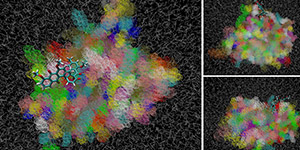
Stage 2: Molecular Dynamics Simulations The top 50 candidates advanced to 100 nanosecond molecular dynamics simulations using GROMACS, run on NCSA Delta GPU resources. These simulations assessed binding stability under physiological conditions — providing a more detailed picture of complex stability than docking scores alone. MD simulations are still ongoing.
Of the 600,000 screened compounds, Tecovirimat ranked only in the 95th percentile, meaning thousands of natural compounds showed stronger predicted binding. Top candidate CNP0000011.0 demonstrated a binding affinity of −10.2 kcal/mol compared to Tecovirimat's −8.9 kcal/mol. The next phase involves laboratory testing of the most promising computational candidates.