Research Topic
Can automating CryoEM data transfer and processing — using Globus and Open OnDemand on ACES — cut the time from data collection to structural results from days to hours?
Project Summary
The CryoEM facility (LBSD-CryoEM) at Texas A&M University supports a wide range of researchers in structural biology, providing critical resources for studies that rely on determining protein structures at near-atomic resolution. This work enables scientists to understand how proteins and protein complexes interact with binding partners or drug-like molecules, and to explore their potential as therapeutic targets.
Data collection happens on a Titan Krios G4 equipped with a Gatan K3 camera and BioContinuum Imaging Filter, generating terabytes of data per day. Managing that volume was one of the central challenges. Their local storage infrastructure couldn't accommodate the sustained data rates, and initial attempts at manual transfers created significant bottlenecks that delayed processing by days. The team transferred data to ACES using Globus, which allowed them to move large datasets reliably without tying up local resources and enabled automated transfers that could run overnight. Microscope data is written to a local Globus endpoint and transferred in near real time using parallel transfers and checkpointing for speed and reliability. A consistent directory structure supports downstream tasks, and once the data arrive, CryoSPARC Live is started for automatic data processing, minimizing delay between collection and analysis.
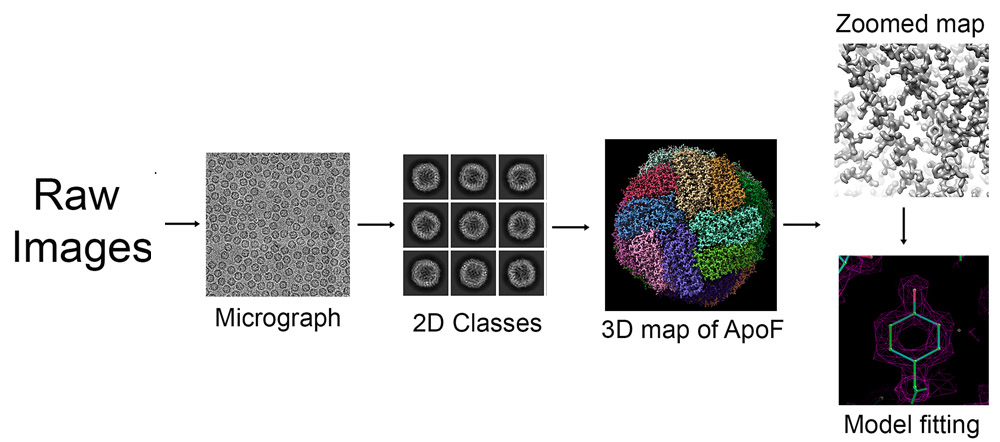
Processing is handled through CryoSPARC and RELION, accessed via the Open OnDemand portal on ACES. They structured jobs to take advantage of ACES' GPU nodes, running motion correction and CTF estimation interactively during data collection. The iterative nature of particle picking and classification meant they could rapidly test parameters through Open OnDemand's interactive sessions, then submit optimized workflows as batch jobs. The team uses CryoSPARC Live for automatic job scheduling and sbatch for RELION job scheduling. This hybrid approach reduced their time-to-first-results from days to hours, critical when working with time-sensitive samples. The ability to run computationally intensive jobs at scale was critical given the dataset sizes involved in resolving these channel structures.
For cryo-ET, they analyze these complexes in their native cellular context using IMOD for tomogram reconstruction and PEET/emClarity for subtomogram averaging. The ACES cluster's large-memory nodes proved essential for handling the memory-intensive 3D reconstruction algorithms required for tomographic data. The team developed custom scripts to integrate single-particle and tomographic workflows, providing structural insight that complements the single-particle work and informs their understanding of how these channels behave in situ. A typical cryoEM project using CryoSPARC Live requires 5–10 TB of storage, 128–256 GB of system memory, and three GPUs with 24–48 GB of VRAM each.
The combination of Globus data management, Open OnDemand accessibility, and ACES' specialized hardware enabled the research group to process datasets that would have been computationally prohibitive on traditional university clusters, ultimately allowing them to resolve ion channel structures to resolutions sufficient for drug design — work that directly informs their collaborative efforts with pharmaceutical partners developing new therapeutics for neurological disorders.