Research Topic
How does tube deformability control bubble pinch-off during fluid displacement — and can computational modeling predict it?
Project Summary
In this project, the team developed a novel computational fluid-structure interaction (FSI) framework to simulate the dynamics of two immiscible fluids moving through a soft capillary tube. The core challenge was coupling complex multi-physics phenomena: two-component fluid flow with topological changes, nonlinear solid deformation, surface tension effects, and dynamic wetting — a combination that had not previously been modeled together.
The team used a phase-field model for the fluids and a nonlinear large-deformation model for the solid tube, with both spatially discretized using Isogeometric Analysis (IGA). For the FSI simulations, the team used customized codes built using the open-source HPC libraries PETSc and PetIGA. The team installed their customized codes with support from the PSC team. Most importantly, because the relevant PETSc/PetIGA modules were not available on Bridges-2, the team had to ensure compatibility between the GCC, OpenMPI compilers and PETSc/PetIGA codes during compilation and installation.
The computations were too expensive to be run on the team’s local resources because solving the FSI problem required high memory, the need for parallel computing resources, and the need for high spatial and temporal accuracies. So, the team carried out simulations on Bridges-2 at the Pittsburgh Supercomputing Center via ACCESS. Each simulation used 128 CPU cores and typically ran for 12-15 hours. In total, the team performed about 200 simulation runs for code validation against experiments, mesh refinement studies, parametric studies and code optimizations.The team also used OnDemand to run and monitor the jobs, and to visualize the simulation results.
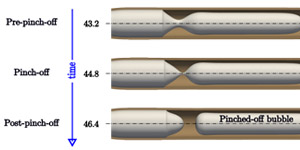
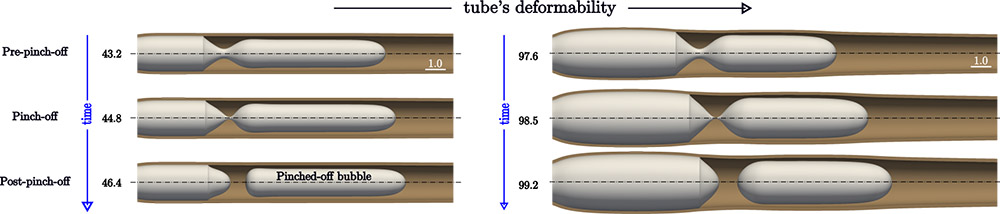
A key finding from this project was that tube's deformability delays or suppresses bubble pinch-off compared to rigid tubes — with different mechanisms at play in wetting versus non-wetting tubes. At the start of this project, the team hypothesized that non-wetting soft tubes would accelerate bubble pinch-off, but their simulations revealed two competing mechanisms in non-wetting tubes that eventually caused a delay (or suppression) in bubble pinch-off. The team's findings are important in many applications, including soft robotics, enhanced oil recovery, inkjet printing, bio-microfluidics, and manufacturing, where the deformability and wettability of the confining system can be tuned to control the size, shape, and timing of the pinched-off bubble.
When running challenging multiphysics simulations, the team advises future researchers to first perform preliminary scaling tests to identify the optimal number of CPU cores. Small test cases can be run on the RM-shared partition (maximum of 64 cores per node), while larger test cases can be run on RM nodes with 128 cores per node. For memory-intensive simulations, the team recommends the researchers to use the RM-512 partition with 512 GB RAM per node or request Extreme Memory nodes with up to 4 TB RAM per node. Linear solvers, nonlinear solvers and solver preconditioners should be carefully selected, as they can affect runtime. For restarting the simulations at a later time or simulations that exceed wall-time limits, researchers should use checkpoint/restart files. For deadline-driven jobs, the team advises researchers to reserve nodes ahead of time.